Max Altitude
6812
Difficulty
Extreme
Accomodation
Teahouses + Camping
Meals
Breakfast, Lunch and Dinner
Region
Everest
Duration
28 days
Pricing
-
6812
Extreme
Teahouses + Camping
Breakfast, Lunch and Dinner
Everest
28 days
-
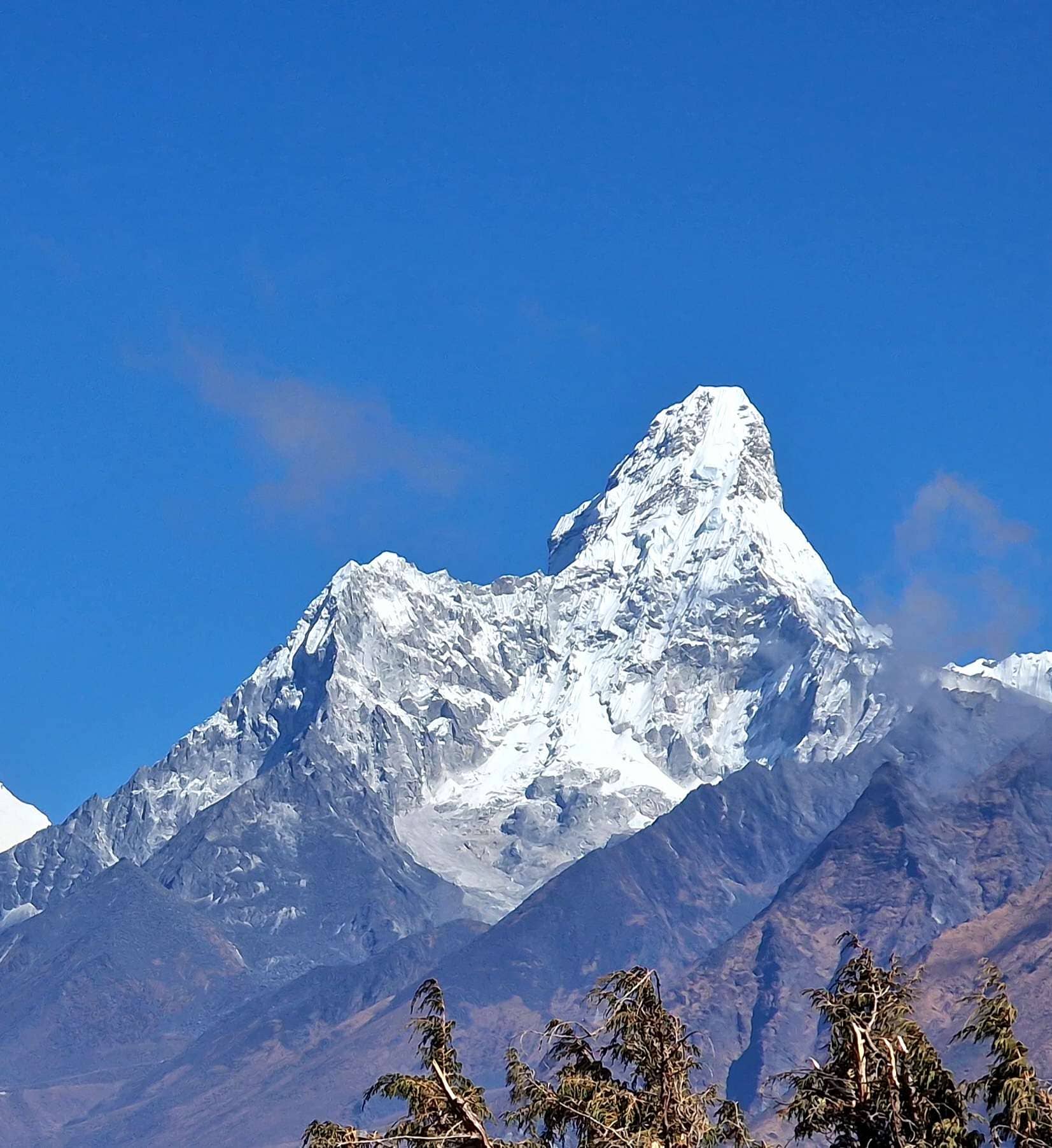
For countless adventurers, Ama Dablam is the ultimate mountain to conquer! Its stunning prominence and breath taking beauty make it a true gem in the Himalayas. But don’t be fooled—this mountain offers a challenge that will push even the most seasoned mountaineers to their limits. Get ready for an unforgettable journey filled with incredible views a sense of achievement that’s simply unmatched!
We include Lobuche Peak as an acclimatisation peak to enhance your chances of success on Ama Dablam. This strategic addition helps climbers adapt to the altitude while building skills and confidence. By summiting Lobuche, you’ll be better prepared for the challenges that await on Ama Dablam, ensuring a more enjoyable and successful climbing experience.
Day 1 – Arrival in Kathmandu
Day 2 – Fly to Lukla → Trek to Benkar – 2630m – 5 – 6 hrs
Day 3 – Trek Benkar → Namche – 3440m – 4 – 5 hrs
Day 4 – Acclimatisation day Namche
Day 5 – Trek Namche → Tengboche – 3867m – 5 – 6 hrs
Day 6 – Trek Tengboche → Dingboche – 4110m – 6 – 7 hrs
Day 7 – Dingboche acclimatisation day
Day 8 – Trek Dingboche → Lobuche – 4900m – 5 – 6 hrs
Day 9 – Trek Lobuche → Gorak Shep – 5100m – 2 – 3 hrs then to EBC (5364 m)
Day 10 – Climb Kalapatthar (5545m) → Lobuche – 4900m – 2 – 3 hrs
Day 11 – Trek Lobuche → Lobuche High camp – 5600 m – 4 – 5 hrs
Day 12 – Summit Lobuche Peak – 6119 m → Periche
Day 13 – Trek Periche → Ama Dablam Base Camp – 5003m – 7 – 8 hrs
Day 14 – 21 – Climbing period on Ama Dablam preparing for climb
– Summit attempt of Ama Dablam returning to camp 2
– Camp 2 → Ama Dablam Base Camp
Day 22 – Ama Dablam Base Camp → Namche
Day 23 – Namche → Lukla
Day 24 – Fly to Kathmandu
Day 25 – End of itinerary
Upon arrival in Tribhuvan International Airport a representative from Dare to Dream adventures will be there to greet you and take you to your hotel in Thamel, an area of Kathmandu famous for all its trekking shops and a wide variety of restaurants and bars.
Upon checking in to your hotel you will then have the rest of the day at your leisure to explore Kathmandu.
A welcome meeting will be scheduled for the group for early evening to go over the details of the trip, meet the team, and give you an opportunity to ask any questions.
You will then have the rest of the evening to relax, have dinner, or buy any last-minute essentials for the trek before the excitement begins the next morning.
Please note – if you have booked additional days in Kathmandu then the welcome meeting will be on the official first day of the trek and you will be informed about the time when collected at the airport.
Day 2 – Flight to Lukla (2850m) then trek to Benkar (2630m) – 5 – 6 hour trek
We will try where possible to fly from Kathmandu but in the height of the season where Kathmandu isn’t available you will be transported to Ramechapp Airport, around a 4 – 5 hour drive from Kathmandu.
You will board the plane to Lukla and enjoy a 20 – 30 minute thrilling flight with some of the most incredible views you will ever see. For many, this is the first opportunity to catch a glimpse of Everest and the magnificent Himalayas. The landing into Lukla is also an experience.
Upon arriving in Lukla a Dare to Dream representative will collect you and will take you for a breakfast stop to meet the rest of the team.
After breakfast, we will then start our trek to Benkar. The first part of the trek is downhill and follows the Dudh Koshi River. It offers spectacular views of the lower Khumbu region. You will pass through a number of Sherpa villages and get an opportunity to see the farming practices. Throughout the trek, you will get to see many important aspects of the Buddhist religion including mani stones – Tibetan inscribed prayer stones – brightly colored prayer flags, stupas, and prayer wheels.
You also experience your first suspension bridges today. Remember to keep your eyes peeled for wildlife in the area.
Day 3 – Trek Benkar – Namche Bazarre (3440m) – 4 – 5 hours
After a short walk of around 1hr, you will reach Monjo at which point you will pass into Sagarmantha national park.
You will descend down and walk alongside the Dudh Koshi river through winding paths and pine forests.
You will see some beautiful cascading waterfalls today.
Not before long the sight of the Hilary Suspension bridge will greet you. This is a famous photo opportunity. You may even be lucky to catch a bungee jumper.
The bridge marks the start of the Top Dada (Namche Hill). The climb will take around 2 hours. Around halfway up you will get your first opportunity to see Mt Everest and Lhotse – cameras at the ready.
Onwards and upwards you will reach the hustling Sherpa town of Namche Bizarre – the gateway to the Himalayas.
You will have some free time to explore and visit the many shops, bakeries, and restaurants that Namche has to offer.
Day 4 – Namche Acclimatisation Day
To help with the acclimatization process we will work on the trek high sleep low principle.
After breakfast, we will start off with a hike up to Syangboche – up to a max altitude of around 3900m – where we will see the government yak farm, the telecom tower, and Graveyard monument. You will get views down to Khumjung Village below and across to Phortse, Tengboche, and Pangboche.
From here the mountain views are spectacular. Some of the mountains you will see include Khumbi Yu Lha (5761m), Tabuche (6367m), Nuptse (7861m), Everest (8848m), Lhotse (8516m), Peak 38 (7519m), Ama Dablam (6856m), and Thanserku (6608m) to name a few. Your guide will point these out to you.
On the descent, there is the opportunity to visit The Nest – a museum about the waste management in Everest Region. Here you get a chance to climb Everest to the South Col via VR – it feels so real and a worthwhile experience.
In the afternoon we will take you to visit the Sherpa cultural museum – a real-life Sherpa house, and also to another museum to learn about the history of the summits of Everest. Here there is also another viewpoint with views to Everest, Lhotse, Nuptse, and Ama Dablam.
Day 5 – Namche – Tengboche (3867m) – 5 – 6 hours
After leaving Namche we start the trek for today on fairly easy-going terrain – Nepali flat – some ups and downs.
We pass the cut off for Gokyo in Sonassa.
A lot of today’s walk is spent through the pine forests. Today offers a great chance to try and spot some wildlife: colorful pheasants – the national bird of Nepal; musk deer – a very rare species and if you are very lucky you may catch a glimpse of a red panda.
Depending on the time of the year the Rhododendron bushes may be in full bloom.
After a descent down to the riverside to Phungi Tanga where we will stop for lunch, we will then commence the demanding climb up Tengboche Hill.
Upon reaching the top you will see Tengboche Monastery.
We may stay here or continue on for another 30 minutes to Deboche where we will stay for the evening.
Day 6 – Tengboche / Deboche – Dingboche (4410m) 4 – 5hours
The route continues through the Rhododendron and birch forests and slowly the scenery starts to change. After around 2 hours we will stop for a visit at Upper Pangboche monastery to see the Yeti skull and hand (optional).
We will then make our way to Somare for lunch.
The terrain changes again, you will see the last tree line and it becomes much more rocky.
For the final 30 minutes, the trek becomes much steeper but soon you are rewarded with the views of the stupas surrounding Dingboche.
Day 7 – Dingboche Acclimatisation Day (4800m)
Today we will climb Nagarsang Peak up to 4800m. On the way you can see many beautiful mountains including a close-up of Ama Dablam. Island Peak (6189m) is also very clear from here. You can see three 8000m peaks from here Makalu (8485m), Cho Oyu (8201m), and Lhotse (8516m). You can also see the second most popular climbing peak in the Everest Region Lobuche East (6119m).
You will have a free afternoon to explore Dingboche and visit some of the excellent bakeries in the town. Dingboche is unique as all the fields are walled to protect crops from animals and weather.
Day 8 – Dingboche – Lobuche (4900m) 6 – 7 hours
Upon leaving Dingboche you will leave the beautiful view down the Khumbu Valley behind. You will begin walking up the Khumbu Khola Valley heading towards Thukla where we will stop for lunch. Looking back down you will get a beautiful view to Ama Dablam and to the village of Periche below.
To your left, the mountains of Tabuche and Cholatse sit prominently. You can see Dongla Lake at the bottom of Cholatse.
After lunch, there is a steep climb towards the Everest Memorial, an opportunity to pay your respects to the fallen climbers of Everest. You then begin to walk beside the Everest Glacier passing the Great Himalayan Trail route before arriving in Lobuche Village.
Day 9 – Lobuche to Gorak Shep (5100m) then onto Everest Base Camp (5364m)
The Nuptse Wall faces you as you leave your teahouse in Lobuche. After around 1hr you will start to walk on the Everest Glacier towards Gorak Shep. The paths are rocky and narrow with loose rock so care must be taken.
Upon arrival in Gorak Shep lunch will be served.
The time has come to finally make your way to Everest Base Camp. It is a 2 – 2.5hr walk to EBC. The terrain is undulating with loose rock and some areas which do have some easily avoidable exposure.
Upon arrival it’s time to celebrate and enjoy the moment. You have done it! You have made it to EBC. Enough time will be spent at EBC for you to get all your photos and when everyone is ready, we will return to Gorak Shep – you will be tired but satisfied. Congratulations you have made it to EBC!
Day 10 – Kalapatthar (5645m) – Gorak Shep – Lobuche
Today you have an opportunity to get up early (approx. 4am) and climb several hours up Kalapatthar. We aim to get up to the top for sunrise to watch the sun come up on some of the world’s biggest mountains. Certainly, an experience you will NEVER forget.
Breakfast will then be served and we will begin to retrace our steps back down to Lobuche.
The afternoon will be spent at a climbing training workshop. We will go over the use of the technical equipment and techniques required for the climb. Finally, a check will be carried out on the climbing equipment to ensure everything is present and correct.
Day 11 – Lobuche – Lobuche East High Camp (5600m) 4 – 5 hours
After breakfast, we will start heading towards Lobuche East Base Camp. You follow the Grand Himalayan Trail then leave the route to head towards base camp.
Upon leaving base camp there is a steep climb on rock scree moraine towards high camp where we will have lunch.
The afternoon will be spent doing further training if required or having a good rest for the day ahead.
Final checks of climbing equipment will be carried out before an early dinner and early night.
Day 12 – Lobuche East Summit Day – Periche
The time has come to summit your first of the two peaks of the expedition.
After an early morning wake-up and a light breakfast, we will start our summit attempt of Lobuche East. The terrain will initially be very steep over flat, bedded rock (depending on weather climbing equipment and ropes may be required).
After 2.5 – 3 hours crampon point will be reached – a chance to have a quick drink and put on your climbing gear. The terrain can vary depending on the time of the year but it is often snow or ice. After 3 – 4 hours the summit of Lobuche East will be in sight.
Upon reaching the summit at 6119m you will have a chance to experience the 360-degree panoramic views, take lots of pictures and capture the moment.
Chances are limited to traverse the difficult ridge to Lobuche Central Peak.
After descending, the night will be spent at Pheriche.
Day 13 – Pheriche – Ama Dablam Base Camp
A short walk today to allow you to recover after your summit attempt yesterday. A chance to have a rest and some free time.
Day 14 – 21 –
Various rotations and training opportunities to prepare you for your summit push of Ama Dablam.
Due to the rotational nature of the climb, we will provide a short description of the various stages and what to expect between camps as the exact itinerary will depend on the progress of the group and environmental factors.
Ama Dablam base camp – high camp (2 – 3 hours)
Taking approximately 2 – 3 hours the climb is fairly steep up a rocky and grassy moraine. A moraine consists of materials carried and dumped by a glacier.
High camp – Camp 1
This climb takes approximately 1 – 2 hours. Although not far in terms of distance this section requires you to scramble over lots of loose rock.
Camp 1 – Camp 2 (5950m)
This journey is a very challenging climb with lots of loose rock. It includes some traverses across pinnacles and some rock-climbing including overhangs. It should take approximately 3 – 4 hours
Final Summit push from Camp 2
Today will be a long day with 10 – 13 hours of climbing.
The day starts with a tricky traverse over a short but very narrow ridge with extreme exposure before the great colouir – also known as the grey tower – a mass of exposed grey rock presenting a challenging climb. The terrain will become a mixture of snow, ice, and rock the higher you get. You will then approach camp 3.
Camp 3 to the summit
Upon reaching the summit we will spend a short time to allow for photographs and an appreciation of the incredible surroundings. We think you will find it emotional given the magnitude of what you have achieved – to make it to the summit of Ama Dablam is a real mountaineering achievement.
We will then start our descent back to Camp 2.
Camp 2 – Ama Dablam Base Camp
Retracing our steps back to Base camp.
Day 22 – Ama Dablam Base Camp to Namche
Today is spent retracing your steps back to Namche Bazarre.
You will have some free time to once again visit the local shops and bars/restaurants. Maybe even grab a beer and celebrate your achievements.
Day 23 – Namche to Lukla
Another long walk today returns us to our starting point in the village of Lukla. Most of today is spent going downhill – with a bit of Nepali flat for good measure – but the day ends with a long but manageable climb back up to Lukla.
Tonight, you will say farewell to the mountain team. We will have a farewell dinner with them in the teahouse and tips are handed out.
Day 24 – Early morning flight and return to Kathmandu
We will have an early start this morning once more. You will have breakfast before your guides take you back to where it all began at Lukla airport. A last farewell as you board the plane to your guides.
On the flight, you will get your last mountain views. Many find this a very emotional journey as the reality of what you have achieved hits.
Upon arrival back in Kathmandu, you will get an opportunity to have some free time and enjoy a luxurious shower in our stylish hotel in Kathmandu before getting collected to head to our carefully selected and delicious farewell dinner restaurant.
Day 25 – End of itinerary
For those not booking extra nights in Kathmandu your itinerary ends today.
We will collect you from your hotel and take you back to Tribhuvan International Airport ready for your onwards journey.
For those booking extra nights we will follow the same information above on your required date.
Ama Dablam has received the grading of a TD climb and a fitness level of 5.
Ama Dablam is a highly technical mountain that requires climbers to be experienced mountaineers. Experience is required in rock climbing, ice climbing and high altitude mountaineering.
Ama Dablam requires climbers to have a very high fitness level and a strong mindset to get them to the top.
Customers must have high altitude experience and previous technical experience on a 6000m + mountain such as Island Peak, Lobuche or similar. More technical climbing at lower altitudes would also be accepted.
Customers should also have experience at multipitch climbing (rock or ice) above a grade 5.8 a,b or c.
If you are unsure if you have the skills required for this climb please contact us and a member of the team will advise you.
Ensuring you have the correct skillset for the expedition is very important to us as safety is always our first priority.
✓ Two nights’ luxury hotel accommodation in Kathmandu (twin sharing, breakfast included)
✓ All airport transfers in Nepal
✓ Internal flights to Lukla (may depart from Ramechapp during peak season)
✓ All trek accommodation (teahouse and camping as required)
✓ Breakfast, lunch, dinner on trek + one hot drink per meal
✓ Filtered water (where available)
✓ Required trek/climbing permits.
✓ Experienced English speaking guides (registered, insured)
✓ Porter – 1 porter client – 30kg allowance (expenses/insurance covered)
✓ Medical supplies + assigned first-aid personnel
✓ Daily oximeter checks (twice/day)
✓ Emergency evacuation coordination (costs covered by your insurance)
✓ Government taxes and fees
✗ Meals in Kathmandu (outside breakfast)
✗ Mandatory travel insurance (must cover high-altitude rescue)
✗ International flights
✗ Nepal entry visa
✗ Extra drinks/snacks, WiFi, hot showers, battery charging
✗ Personal expenses
✗ Tips for staff (expected)
✗ Excess baggage (>10kg on Lukla flight)
✗ Additional nights/expenses due to delays (e.g., weather)
✗ Hotel upgrades or optional helicopter descents